Hoodi Validator Use Cases and Data Flows
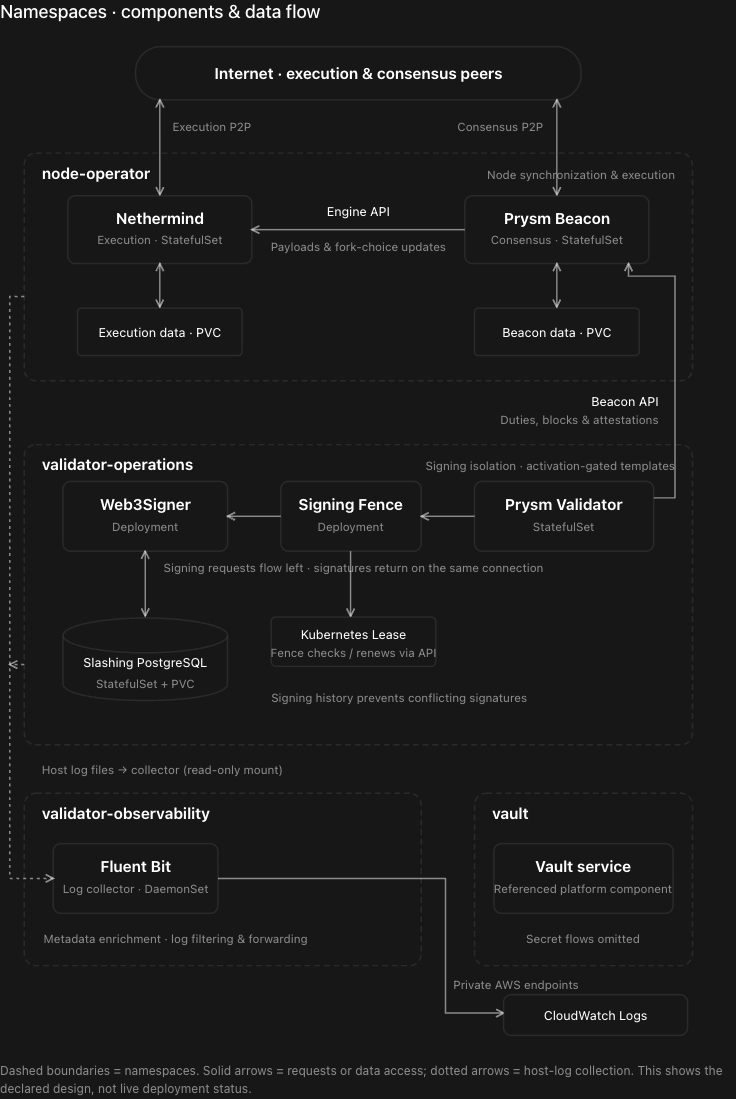
The platform separates validator operations into four Kubernetes namespaces. This article follows the data flows between them, from node synchronization to the safe signing and broadcast of validator duties.
Refer to this diagram and Kubernetes Namespace Design for a Hoodi Validator to see how I implemented the validator components in Kubernetes.
node-operator
    Nethermind
    Prysm Beacon
    Execution and beacon data

validator-operations
    Prysm Validator
    Signing Fence
    Web3Signer
    Slashing PostgreSQL
    Kubernetes Lease

validator-observability
    Fluent Bit

vault
    Vault service
Synchronize the Hoodi Node
Nethermind synchronizes execution-layer data, while Prysm Beacon synchronizes consensus-layer data. Both clients require persistent storage and exchange execution payloads through the Engine API.
flowchart LR
    EP[Hoodi execution peers] --> N[Nethermind]
    CP[Hoodi consensus peers] --> B[Prysm Beacon]

    N <--> ED[(Execution data PVC)]
    B <--> BD[(Beacon data PVC)]

    B <-->|Engine API| N
- Nethermind receives execution blocks and transactions from execution peers.
- Nethermind validates and stores execution state.
- Prysm Beacon receives beacon blocks and consensus messages.
- Prysm Beacon validates and stores beacon-chain state.
- Prysm Beacon sends execution payloads to Nethermind through the Engine API.
- Nethermind returns the execution-validation result.
- Both clients continue until they reach the current Hoodi head.
For example, when a beacon block contains an execution payload, Prysm Beacon asks Nethermind whether the payload is valid for the current state. Nethermind can return VALID, INVALID, or SYNCING.
The validator cannot safely operate until Prysm Beacon can provide current chain state.
Validate a Received Block
Prysm Beacon evaluates consensus rules and delegates execution-payload validation to Nethermind. A block is accepted only when both parts of the validation succeed.
sequenceDiagram
    participant Peer as Consensus peer
    participant Beacon as Prysm Beacon
    participant Exec as Nethermind
    participant DB as Execution data PVC

    Peer->>Beacon: Send beacon block
    Beacon->>Beacon: Validate consensus rules
    Beacon->>Exec: Submit execution payload through Engine API
    Exec->>Exec: Validate transactions and state transition
    Exec->>DB: Read/write execution state
    Exec-->>Beacon: VALID, INVALID, or SYNCING
    Beacon->>Beacon: Accept or reject block
A block can have a valid consensus signature but an invalid execution payload. In that case, consensus validation passes, execution validation fails, and Prysm Beacon rejects the block.
Prysm Beacon owns the consensus decision. Nethermind owns the execution decision.
Obtain a Validator Duty
Prysm Validator does not independently decide what to attest or propose. It requests its assignments from Prysm Beacon, which reads the current beacon-chain state.
sequenceDiagram
    participant VC as Prysm Validator
    participant Beacon as Prysm Beacon
    participant State as Beacon-chain state

    VC->>Beacon: Request validator duties
    Beacon->>State: Read current epoch and assignments
    State-->>Beacon: Validator assignment
    Beacon-->>VC: Attestation, proposal, or sync-committee duty
    VC->>VC: Build required consensus message
For example, Prysm Beacon can assign validator 98765 an attestation duty for slot 123456, committee 4, and target epoch 3851.
Prysm Validator then obtains the required block root and checkpoint information and prepares the attestation.
Sign an Attestation
The validator client sends the request data, not the private key. Signing Fence confirms current authority before forwarding the request to Web3Signer, which checks slashing history and produces the BLS signature.
sequenceDiagram
    participant VC as Prysm Validator
    participant Fence as Signing Fence
    participant Lease as Kubernetes Lease
    participant Signer as Web3Signer
    participant DB as Slashing PostgreSQL
    participant Beacon as Prysm Beacon

    VC->>Fence: Attestation signing request
    Fence->>Lease: Check ownership and validity
    Lease-->>Fence: Lease valid
    Fence->>Signer: Forward signing request
    Signer->>DB: Check signing history
    DB-->>Signer: No conflict
    Signer->>Signer: Produce BLS signature
    Signer->>DB: Record accepted signature
    Signer-->>Fence: Return signature
    Fence-->>VC: Return signature
    VC->>Beacon: Submit signed attestation
    Beacon->>Beacon: Broadcast to consensus peers
An attestation request identifies the validator, duty, slot, target epoch, and block root. Web3Signer returns the signature to Prysm Validator through Signing Fence.
Prysm Validator submits the signed attestation to Prysm Beacon, which broadcasts it to consensus peers.
Reject an Unsafe Attestation
The signing flow fails closed. If the Kubernetes Lease is invalid or the slashing database identifies a conflict, Web3Signer does not produce a signature.
flowchart LR
    VC[Prysm Validator] --> F[Signing Fence]
    F --> L{Lease valid?}
    L -->|No| R1[Reject request]
    L -->|Yes| S[Web3Signer]
    S --> D{Slashing conflict?}
    D -->|Yes| R2[Reject request]
    D -->|No| SIG[Create signature]
If another instance owns the Lease, Signing Fence closes or rejects the connection. Web3Signer receives no request, and the validator misses the duty rather than signing unsafely.
If Web3Signer finds an existing signature for the same duty, it rejects the new request. This is the intended fail-closed behavior.
Propose a Block
Block proposal combines two separate flows: Nethermind constructs the execution payload, while Web3Signer creates the validator’s block signature.
sequenceDiagram
    participant VC as Prysm Validator
    participant Beacon as Prysm Beacon
    participant Exec as Nethermind
    participant Fence as Signing Fence
    participant Signer as Web3Signer
    participant DB as Slashing PostgreSQL
    participant Peers as Consensus peers

    VC->>Beacon: Report proposer duty
    Beacon->>Exec: Request execution payload
    Exec->>Exec: Select and execute transactions
    Exec-->>Beacon: Return execution payload
    Beacon->>Beacon: Construct beacon block
    VC->>Fence: Request block signature
    Fence->>Signer: Forward approved request
    Signer->>DB: Check proposal history
    DB-->>Signer: No conflict
    Signer-->>Fence: Return block signature
    Fence-->>VC: Return block signature
    VC->>Beacon: Submit signed block
    Beacon->>Peers: Broadcast signed beacon block
For a selected validator and proposer slot, Nethermind creates the execution payload and Web3Signer creates the block signature. The Engine API helps construct and validate the payload; it does not sign the validator’s block proposal.
Enforce One Active Signing Path
The Kubernetes Lease prevents multiple validator paths from reaching the signer simultaneously. It is an active authority control rather than a historical record.
flowchart TD
    A[Signing Fence starts] --> B[Read Kubernetes Lease]
    B --> C{Lease available?}
    C -->|Yes| D[Acquire or renew Lease]
    D --> E[Allow validator signing traffic]
    C -->|No| F[Reject signing traffic]
    E --> G{Lease remains valid?}
    G -->|Yes| E
    G -->|No| H[Close listener and active connections]
When Validator A owns the Lease through Fence A, its signing traffic is allowed. Validator B, using Fence B, is rejected while that Lease remains held.
The Lease answers, “Who may sign now?” Slashing PostgreSQL answers, “What has already been signed?” Both protections are required.
Submit a Block After Signing
Web3Signer never broadcasts directly to the network. After it returns a signature, Prysm Validator attaches it to the signed object and submits it to Prysm Beacon.
flowchart LR
    S[Web3Signer] --> F[Signing Fence]
    F --> VC[Prysm Validator]
    VC --> B[Prysm Beacon]
    B --> P[Consensus peers]
Prysm Beacon validates the completed object and broadcasts it to consensus peers. This keeps peer-to-peer networking and validator key operations in separate components.